Year: 2017 (page 2 of 2)

Nordic Wittgenstein Review

A new issue of Nordic Wittgenstein Review was published. It’s Open Access. See below.

NWR is an international full Open Access journal, published by the Nordic Wittgenstein Society http://nordicwittgensteinsociety.org since 2012. It applies a double-blind peer review to papers submitted to the article section, and an additional Open Review to accepted papers.

Best wishes for the holidays!

The editors (2017-2018)
Gisela Bengtsson (Uppsala University)
Tove Österman (Uppsala University)
Yrsa Neuman, editor-in-chief (Åbo Akademi University) until yesterday, henceforth Simo Säätelä (University of Bergen)

PS. CFP! Next submission deadline: August 31 (& continuous). Submission guidelines:
http://www.nordicwittgensteinreview.com/about/submissions


Nordic Wittgenstein Review
Volume 6 / Number 1 (June 2017)
http://www.nordicwittgensteinreview.com/issue/view/241

Farewell from an Editor-in-Chief 5-6
http://www.nordicwittgensteinreview.com/article/view/3455/4142

INVITED PAPER
“Not a Something”
Roger Teichmann 9-30
http://www.nordicwittgensteinreview.com/article/view/3446/4143

ARTICLES
A Passion for Life: Love and Meaning
Camilla Kronqvist 31-51
http://www.nordicwittgensteinreview.com/article/view/3424/4140

Excursus on Wittgenstein’s Rule-Following Considerations
Elek Lane 53-83
http://www.nordicwittgensteinreview.com/article/view/3423/4141

Numbers in Elementary Propositions
Anderson Luis Nakano 85-103
http://www.nordicwittgensteinreview.com/article/view/3438/4139

FROM THE ARCHIVES
The Logbook of Editing Wittgenstein’s “Philosophische Bemerkungen”
Christian Erbacher, Julia Jung & Anne Seibel 105-147
http://www.nordicwittgensteinreview.com/article/view/3442/4144

BOOK REVIEWS
Review of Ian Dearden: “Do Philosophers Talk Nonsense?”
Antony Fredriksson 149-151
http://www.nordicwittgensteinreview.com/article/view/3445/4146

Review of Rebecca Schuman: “Kafka and Wittgenstein”
Hugo Strandberg 153-156
http://www.nordicwittgensteinreview.com/article/view/3447/4145

REPLIES — New section
Matters of Fact and Relations of Ideas
Nuno Venturinha 157-163
http://www.nordicwittgensteinreview.com/article/view/3449/4147


NWR is on Facebook. https://www.facebook.com/NordicWittgensteinReview/

Nordic Wittgenstein Review publishes original contributions on all aspects of Wittgenstein’s thought and work – exegetical studies as well as papers drawing on Wittgensteinian themes and ideas in discussions of contemporary philosophical problems.

The journal is interdisciplinary in character, and publishes contributions in the subject areas of philosophy and other human and social studies including philology, linguistics, cognitive science, and others. Sections include invited paper, interview, peer-reviewed articles, from the archives (in which seminal works are re-published or where previously unpublished archive materials are presented), as well as a book reviews.

The journal is published by the Nordic Wittgenstein Society (NWS). It is Open Access, applies a double-blind peer review process to submitted article section papers, and an additional Open Review of accepted submitted articles. No article publishing charge. Copyright with the author, published with a Creative Commons CC-BY licence.
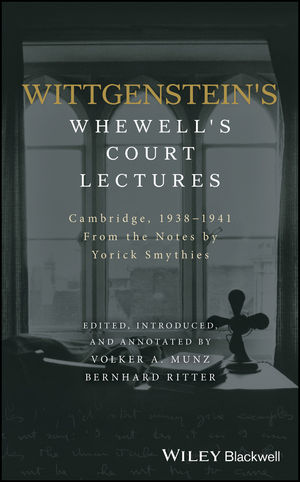
Wittgenstein’s Whewell’s Court Lectures, Cambridge 1938–1941, from the Notes by Yorick Smythies

Wittgenstein’s Whewell’s Court Lectures, Cambridge 1938–1941, from the Notes by Yorick Smythies, will be published on 2nd May 2017.

http://eu.wiley.com/WileyCDA/WileyTitle/productCd-1119166330.html

These are new lecture notes of lectures Wittgenstein delivered in Cambridge. Only three lectures and parts of a fourth of about 70 in total have already been published. Some of the material included in the volume, especially that from 1940 (Lectures on Description, Lectures on Belief…), ranks among the best Wittgenstein lectures that have come to us. They are also among the most reliable, since 98% of the text of these lectures is reproduced from Smythies’ immediate lecture notes, not from rewritten notes or memorized summaries. The volume provides a better understanding of the development of some of Wittgenstein’s ideas, since he sometimes lectured on topics before having written much about them. There are early lectures on certainty (“Puzzle of Trinity College”, Knowledge Lecture 8, Belief Lecture 7) and on concept-formation (Belief Lectures, second half). Wittgenstein also discusses the views of authors on which there is little in his published writings or in the Nachlass, most notably David Hume, Kurt Gödel, and W. E. Johnson. There are also some new philological findings, such as the discovery that the so-called “Lectures on Religious Belief” are a compilation by the former editor. Two of the three lectures were not given at the same time and one remains undatable, which means that it is not where it allegedly should be. Only one of these lectures is reprinted in this new volume.

Wittgenstein and Hegel – Reevaluation of Difference

Wittgenstein and Hegel – Reevaluation of Difference

TU Dresden, Germany

June 28–30, 2017

“Hegel seems to me to be always wanting to say that things which look different are really the same. Whereas my interest is in showing that things which look the same are really different.” (Recollections of Wittgenstein)

CONFIRMED SPEAKERS

James Conant (Chicago)
Rico Gutschmidt (Chicago)
Bruno Haas (Dresden)
Herbert Hrachovec (Vienna)
Karl-Friedrich Kiesow (Hannover)
David Kolb (Bates College)
Ingolf Max (Leipzig)
Aloisia Moser (Linz)
Thomas Rentsch (Dresden)
Pirmin Stekeler-Weithofer (Leipzig)
Gottfried Gabriel (Constance)

ORGANIZED BY

Alexander Berg (TU Dresden & Charles University Prague)
Jakub Mácha (Masaryk University Brno)
Louisa Frintert (TU Dresden)
Marco Kleber (TU Dresden)
Alexander Romahn (University of Leipzig)

HOW TO DETERMINE THE DIFFERENCE “HEGEL AND WITTGENSTEIN”?

Wittgenstein once said: “Hegel seems to me to be always wanting to say that things which look different are really the same. Whereas my interest is in showing that things which look the same are really different.” (Recollections of Wittgenstein, ed. by Rush Rhees, Oxford 1981, p. 157) This difference between Hegel’s and Wittgenstein’s thinking has been seldom raised despite being, from a contemporary point of view, particularly pertinent.

According to Hegel, the purpose of philosophy is to consider the thoughts of its respective periods. While Wittgenstein was a focal point of 20th century philosophical discourse, it was Hegel’s philosophy that brought the essential discourses of the 19th century together. After this convergence different movements began to individuate themselves from his system of thinking, allowing for the development of the analytical-continental split in the 20th Century. This now-outdated conflict, which was promoted by Bradley and Russell, took for granted Hegel and Wittgenstein’s opposing positions and is being replaced by a continuous progression and differentiation of several authors, schools, and philosophical traditions, which themselves are guided by various interests, shades, and transitions.
The term ‘split’, however, is anachronistic, problematic, and, therefore, the two, Hegel und Wittgenstein, must be reconciled. It is because of the lack of overlap between these two internally developed spheres of thought that this schism still exists in 20th Century philosophical scholarship. This stems from the split and the institutions themselves. Subsequently, each has a serious interest in the other’s research, specifically how it might impact their own.
The development is already evident in the tendency to identify a progression from a “Kantian” to a “Hegelian phase” of analytical philosophy as well as in the extension of right and left Hegelian approaches by modern and postmodern concepts.
In this process it has become quite clear that the systemic interests of Wittgenstein and Hegel – be it in philosophy of mind, logic, philosophy of science or in other areas – coincide stronger than anticipated by one-dimensional, traditional paradigmatic analyses. This recognition of shared systematical interests opens up new constructive and productive ways of relating both paradigmatic theories.
Taking this into consideration it is reasonable to suppose that assessing the difference between Wittgenstein and Hegel will outline different intersections of 21st century’s variously differentiated philosophical discourse. We hope that not only will the contemplation of Hegel’s thinking bring about a deeper understanding of Wittgenstein’s research, but that Wittgensteinian scholarship will also allow for new answers to old Hegelian problems. A conjoint holistic philosophical discourse remains our discipline’s ambition.

Suggested topics include, but are not limited to:

Anticipation of Wittgensteinian motives in Hegel’s philosophy
Hegelian motives in Wittgenstein’s thinking
Wittgenstein’s reception of Hegel’s philosophy
The role of Neo-Hegelianism and British idealism in the emergence of analytic philosophy
Differences between Hegel’s and Wittgenstein’s philosophical approaches as they relate to the analytic-continental split

CALL FOR PAPERS

Some slots are reserved for contributed papers. There are no parallel sections. We invite submissions for a 30 minute presentation followed by a 20 minute discussion. Papers may be submitted on any issue falling within the conference theme. Please send an abstract in English or in German as attachment (about 500 words), prepared for multiple blind review, to alexander.berg75@googlemail.com by March 31, 2017. The author’s name and affiliation should be included in the body of the e-mail. Notification of acceptance will be given by April 22, 2017. It should go without saying, but we highly encourage submissions from those who are traditionally under-represented. Conference languages are English and German. For all accepted speakers, we provide free accommodation during the conference.

WEBSITE

For more information, visit our conference website:

http://wittgensteinhegel2017.phidd.de
Please do not hesitate to contact the organizers (alexander.berg75@googlemail.com) if you have any questions about the conference. ​​

The conference is funded by the Graduate Academy of the Dresden University of Technology and by the Excellence Initiative of the Federal Ministry of Education and Research

New funding for Wittgenstein’s house in Skjolden

Press release:

New funding for Wittgenstein’s house in Skjolden

As one of the major sponsors, Luster Sparebank has given a grant of NOK 1 million to the project. This is in addition to NOK 1 million which has been funded by the county of Sogn og Fjordane, in which Wittgenstein’s house is located. There is still a long way for full funding, but with positive response from other key sponsors who will be contacted during the spring, the restoration of Wittgenstein’s house in its original surroundings can already commence within 2017.

The renowned Austrian philosopher and engineer Ludwig Wittgenstein (1889- 1951) is not very well known in Norway. However, every year people from around the world come to visit the site where he built the house in 1913, where he sought solitude to work without distractions. Here, Wittgenstein conducted works that delivered important contributions, not just to language and philosophy of mind, but also to mathematics and studies in aerodynamics.

Today, the house is located near the centre of Skjolden and is being used as a holiday house. The relocation and restoration of the house to its original architectural form, will create a historic and cultural heritage site in Sogn og Fjordane, and become an international tourist attraction.

Upon completion, the Foundation intends to inaugurate the house with its key stakeholders and friends representing Norwegian and international universities with a launch event in June 2019.

The project has received significant interest from across the world. A press delegation from Austria will visit the house in Skjolden in May 2017. Wittgenstein studied at the universities of Berlin, Manchester and Cambridge, which are all engaged in the project and agreed to collaborate to support the restoration of the house.

www.wittgenstein-foundation.com
The Wittgenstein Foundation in Skjolden, March 9th 2017


CFP: WITTGENSTEINIAN APPROACHES TO MORAL PHILOSOPHY (THIRD EDITION)

KU Leuven, Belgium
September 21-23, 2017
KEYNOTE SPEAKERS

James Conant (University of Chicago)
Raimond Gaita (University of Melbourne)
Sophie-Grace Chappell (The Open University)
Edward Harcourt (University of Oxford)
Sabina Lovibond (University of Oxford)
Martin Stokhof (University of Amsterdam)
CALL FOR PAPERS

We invite submissions for a 25 minute presentation followed by a 20 minute discussion. Papers may be submitted on any issue falling within the conference theme. Please send an abstract as attachment (about 500 words), prepared for multiple blind review, to benjamin.demesel@kuleuven.be by April 15, 2017. The author’s name and affiliation should be included in the body of the e-mail. Notification of acceptance will be given by May 15, 2017.

Please note that no financial support can be provided for travel expenses and accommodation.
WEBSITE

For more information, visit our conference website:
https://hiw.kuleuven.be/eng/events/wittgensteinian_approaches/index.html

Please do not hesitate to contact the organizers (benjamin.demesel@kuleuven.be) if you have any questions about the conference. ​​