We regret that these uncertain times have left us with no choice but to cancel the 11th BWS conference from now. The BWS hopes that it will take place at some other point in the future. In the meantime, please stay safe and well isolated!
Author: BWS Vice-President (page 11 of 24)
Sorry – we have had to cancel this event. BWS Occasional Lecture: Problems of Expression in the later Wittgenstein – Michael Campbell.
Mental Health in Education: New Perspectives from Philosophy
Colloquium 17 June 2020
University of Warwick
The University of Warwick is hosting a one-day colloquium, jointly funded by the British Academy and the Philosophy of Education Society of Great Britain, to explore therapeutic philosophical traditions in light of educational issues, and in response to calls by policy makers that schools should be teaching about mental health. Philosophers, psychoanalysts and education researchers will bring their experience and expertise to the conversation. There will be a special focus on Wittgenstein and Stanley Cavell.
Speakers: Josh Cohen (Goldsmiths), Richard Gipps (Oxford), Joanna Moncrieff (UCL), Adrian Skilbeck (IOE/Winchester), Paul Standish (IOE), Emma Williams (Warwick), and ‘in conversation’ with Adam Phillips (psychoanalyst and writer).
Register on Eventbrite (use the password ‘therapy’) or by emailing e.williams.1@warwick.ac.uk
Organised by Emma Williams, Centre for Education Studies, University of Warwick.
Dr. Emma Williams | Associate Professor and Director of Impact | CES
Nova Institute of Philosophy (IFILNOVA)
Faculty of Social Sciences and Humanities – Nova University of Lisbon (NOVA FCSH)
Two-day Masterclass on Wittgenstein’s Epistemology of Religion with Professor José María Ariso (UNIR, Madrid)
Program:
26 February 2020
18-21, FCSH, Av. de Berna, Room TA 03
Religious certainty: What it is and to what extent it can be taught
In the first session, Professor Ariso will present the concept of “religious certainty” he has developed by drawing inspiration from Wittgenstein’s notion of “certainty”. After describing the particular traits of religious certainty, he will address two difficulties derived from this concept. On the one hand, he will explain why religious certainty functions as such even though all its consequences are far from being absolutely clear; on the other hand, he will clarify why, unlike the rest of certainties, the loss of religious certainty does not result in the collapse of the world-picture made up of all certainties. Subsequently, he will analyse the extent to which the teacher can teach religious certainty by acting as a facilitator for its acquisition – if desired – particularly bearing in mind that religious certainty cannot be attained at will.
28 February 2020
10-12, FCSH, Campolide, Room CAN 219
Advantages and paradoxes of regarding omniscience as subjective certainty in Wittgenstein’s sense
In the second session, Professor Ariso will try to facilitate understanding of the concept of “omniscience” by taking into account the terminology developed in Wittgenstein’s On Certainty. Thus, he will start by explaining why omniscience can be regarded neither as grounded knowledge nor as ungrounded or objective certainty. Instead, omniscience might be considered as subjective certainty, which has the advantage of leaving scope for a doubt that enables and strengthens religious faith. Lastly, he will clarify how God’s omniscience would be enriched if He were informed of – without needing to share – our objective certainties, in addition to which he will highlight two paradoxes that would arise if we disagreed with God regarding some of our objective certainties. These paradoxes reveal that even though the believer could not understand God’s statement literally, it might strengthen her faith if she realized and accepted that a true and consistent commitment to such statement entails the suspension of her own capacity for judgment.
José Maria Ariso has studied philosophy at the Complutense University of Madrid. After obtaining his PhD in 2003, he spent some research stays in Norwegian (Bergen) and German (Leipzig, Kassel, TU-Berlin and Frankfurt) universities. Since 2011 he has been an assistant professor in the Department of Education at the International University of La Rioja. He has published books, several chapters in edited volumes and a number of articles in international journals. His main line of investigation is the analysis of Wittgenstein’s later work, but his research interests also cover the fields of philosophy of education, philosophy of psychiatry, philosophy of technology, theory of knowledge and Spanish contemporary philosophy. He is the author of Wahnsinn und Wissen: Zu Wittgensteins Lage und Denkbewegung (Königshausen & Neumann, 2012), the editor of Augmented Reality: Reflections on Its Contribution to Knowledge Formation (De Gruyter, 2017) and the co-editor (with Astrid Wagner) of Rationality Reconsidered: Ortega y Gasset and Wittgenstein on Knowledge, Belief, and Practice (De Gruyter, 2016).
This masterclass is organized within the framework of the FCT-funded project “Epistemology of Religious Belief: Wittgenstein, Grammar and the Contemporary World” (PTDC/FER-FIL/32203/2017, PI: Nuno Venturinha), hosted by the Reasoning and Argumentation Laboratory (ArgLab) of IFILNOVA.
Attendance is free of charge.For more information about the project, please visit: https://www.arglab.ifilnova.pt/en/projects/erb
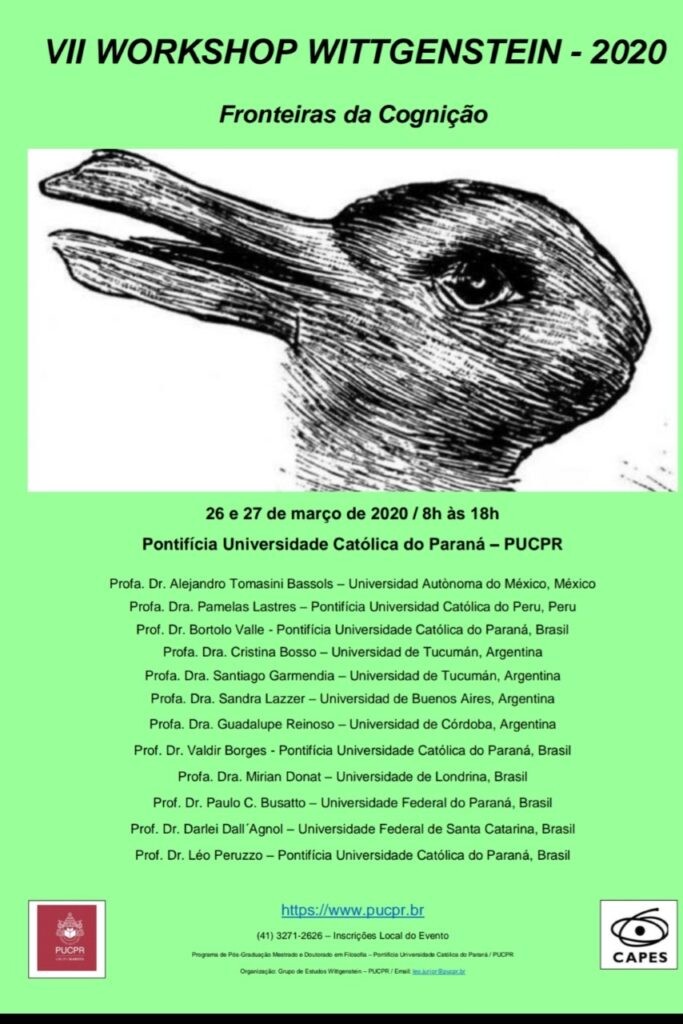
Destaque – 11 fev 2020
Evento reunirá pesquisadores de diferentes países da América Latina
Durante os dias 26 e 27 de março, a PUCPR sediará o VII Workshop Wittgenstein: Fronteiras da Cognição, evento que contará com a presença de pesquisadores do Brasil, Argentina, México e Peru para discutir os limites e conexões entre linguagem e cognição, a partir da visão do filósofo austríaco Ludwig Wittgenstein.
Wittgenstein foi um dos pensadores mais influentes do século XX e colocou a linguagem no centro de suas pesquisas, destacando-se no campo linguístico e posicionando o tema em um outro patamar de importância. “É notório que utilizamos modelos semânticos para compreender e significar a realidade, mas precisamos avaliar quais são estes limites e como tais questões repercutem em domínios particulares das ciências em geral. O trabalho de Wittgenstein não está restrito apenas ao domínio da investigação filosófica, mas tem despertado pesquisas cada vez mais significativas em áreas como Matemática, Física e Direito”, explica o professor Léo Peruzzo, um dos organizadores do evento.
O workshop será aberto ao público e as inscrições devem ser feitas na Escola de Educação e Humanidades, onde o evento ocorrerá.
O VII Workshop Wittgenstein: Fronteiras da Cognição é uma realização do Grupo de Pesquisa Wittgenstein, em parceria com o Programa de Pós-Graduação em Filosofia (PPGF) da PUCPR, e apoio do CNPQ/CAPES.
Serviço:
VII Workshop Wittgenstein: Fronteiras da Cognição
Data: 26 e 27 de Março
Horário: das 8h às 18h
Local: Escola de Educação e Humanidades
Inscrições: Escola de Educação e Humanidades – (41) 3271-2626

Gregynog Hall (http://www.gregynog.org/)
WELSH PHILOSOPHICAL SOCIETY
Gregynog Hall,
Friday 24th April to Sunday 26th April 2020 56th Session
Friday, 24th April
4 p.m. Tea
4.30 pm Michael Campbell (Pardubice), “’Each word a little face’: some remarks on Expression”
7.00 p.m. Dinner
8.00 p.m. Discussion of Cora Diamond’s paper ‘Rules: looking in the right place’
Saturday, 25th April
8 a.m. Breakfast
10 a.m. Annual Wittgenstein Lecture Sonia Sedivy (Toronto), ‘Themes in the Later Wittgenstein and Aesthetics’
11 a.m. Coffee, followed by discussion of paper
12.30 p.m. Short business meeting
1 p.m. Lunch
4 p.m. Tea
4.30 p.m. Rachel Wiseman (Liverpool), ‘What if the private linguist is a poet? Iris Murdoch on “S”‘
7.00 p.m. Dinner
Sunday, 26th April
8 a.m. Breakfast
9.15 a.m. Lawrence Blum (Massachusetts), ‘Iris Murdoch’s political philosophy in Metaphysics as a Guide to Morals’
10.15 a.m. Coffee & Discussion
11.45 a.m. Departure Agenda for Short Business Meeting
1. Arrangements for next meeting
2. AOB
If you would like to attend the meeting please complete and return the form electronically, and send the requisite payment. The deadline for registration is Monday 24th February. While it may well be possible to register after this date – and it will certainly be worth asking – I cannot offer any guarantees. That aside, if the meeting is over-subscribed priority will be given to those who register first. So if you want to come it is a good idea to register immediately.
David Cockburn
The conference is sponsored by generous contributions from the British Wittgenstein Society.
April 22 @ 6:15 pm – 8:00 pm
New College of the Humanities, Bloomsbury, London
Problems of Expression in the later Wittgenstein
The concept of ‘expression’ recurs throughout the Philosophical Investigations. The expressive is important in part because it seems to straddle the categories of the logical and the psychological. These concerns meet in Wittgenstein’s discussion of Moore’s Paradox, where an expression of a state of mind and a description of the world collide. In this talk I will consider some of the points at which Wittgenstein finds problems in the category of the expressive, and will reflect on what philosophical lessons we might learn from them.
Michael Campbell is a Research Fellow in The Centre for Ethics at the University of Pardubice. He works at the intersection between theoretical and engaged ethics, with particular focus on conceptions of human nature and their role in moral thought. His articles have appeared in journals including the Journal of Value Inquiry, Asian Bioethics Review, Philosophical Investigations and the Indian Journal of Medical Ethics. He is co-editor of Wittgenstein and Perception (Routledge, 2015) and Ethics Society and Politics: Themes from the Philosophy of Peter Winch (Springer, 2020).+ GOOGLE CALENDAR+ ICAL EXPORT
Details
Date: April 22 Time: 6:15 pm – 8:00 pm
Organiser
BWS Events Email: events@britishwittgensteinsociety.org
Very sad news. Roger Scruton was one of the strongest voices of our time to promote aesthetics as crucial to the human environment; indeed, to humanity. For all of his controversial views, Roger was a Renaissance man with a deep love of literature and a respect for Leavisian views of the importance of literature in our lives. He was a great supporter of the British Wittgenstein Society — graciously accepting all our invitations despite his heavy commitments because he believed in the society’s mission to encourage and disseminate Wittgenstein studies. I have deeply valued his friendship over the years, and will never forget this admirable man.
Daniele Moyal-Sharrock
BWS president

Call for Papers
Title: 2020 Wittgenstein and Traditional German Philosophy
What can be done by comparing between one philosopher and another? We aim to create a new basis for discussion, and to bridge the gap between Wittgenstein and traditional German philosophers.
Two workshops have been held in Europe on ‘Hegel and Wittgenstein’. You can see the result in the collected papers ‘Wittgenstein and Hegel –Reevaluation of Difference’, where the experts of a particular philosopher explore the possibilities of a philosophical discussion beyond their professional frameworks. This Tokyo workshop can be called an extra edition of the workshops in Europe (http://wittgensteinhegel2017.weebly.com/negativity-and-language.html). Feel free to join and create new connections between people, between a philosopher and another philosopher, and between words and words.
This workshop is not only about Wittgenstein and traditional German philosophy. It’s also a partnership between Asian and European philosophers. From Japan, Professor Taiju Okochi (Kyoto University, Kyoto) will participate as an invited speaker. From Europe, Ph.D. Alexander Berg (Charles University, Prague), the organizer of the previous workshops, and Professor Jakub Mácha (Masaryk University, Brno), who worked with Alexander Berg to compile the collected papers. Let’s share the reality of philosophizing with us in Tokyo.
The organizers of the workshop in Tokyo is Saori Makino (Chiba University, Chiba), a Wittgenstein researcher, and Shuhei Kimoto (Tokyo Metropolitan University, Tokyo), a Hegel researcher. We will make every effort for the success of the workshop. Of course, your participation will make the workshop better.
Text:
Abstracts (under 400 words) should be send to morerain19@gmail.com by 31th January 2020.
Abstracts should be ready for double-blind review, we thus ask to remove any identification detail from the abstract. We kindly ask to send the author’s name, paper title, and affiliation in the body of the email.
Notifications of acceptance will be sent out by 15th February 2020.
The workshop will be guided by Taiju Okochi and Yuji Kurihara
Organizers: Saori Makino and Shuhei Kimoto
Infos:
E-mail Address for submission: morerain19@gmail.com
Deadline: 31th January 2020
Venue: Tokyo Metropolitan University (Minami-Osawa campus)
Dates: 11th-12th April 2020
CFPOrganizing Institution: Tokyo Metropolitan University
I am deeply saddened by the news that Brian McGuinness, eminent Wittgenstein scholar and my very dear friend, is no longer with us. Brian was, for me, the incarnation of ‘a gentleman and a scholar’. I met him at my first ‘Kirchberg’: he welcomed my request to join him at his table Unter den Linden, and quickly dissipated my nervousness upon learning who it was I had just joined for lunch. Brian’s impeccable appearance and demeanour never hid his warm humanity and humorous spirit. His scholarship, just as impeccable, was compounded by a formidable memory, psychological acuity, incisive wit, and compelling honesty. Brian never failed to express his thoughts, never skirted the truth, whether it concerned you or himself. I will miss him enormously.
The last time I saw Brian was at a workshop organised in his honour by Alois Pichler in December 2018 near his home in Siena: Editing Wittgenstein’s Nachlass: A Workshop in Honour of Brian Francis McGuinness. The pictures below were taken on that occasion.
Brian McGuinness was a Fellow and Tutor at Queen’s College, Oxford from 1953 to 1988 before becoming Professor at the University of Siena, Italy, from 1990 until his retirement. Best known for his translation, with David Pears, of Wittgenstein’s Tractatus-Logico-Philosophicus, McGuinness was also an incomparable historian of philosophy. His numerous publications include the universally-acclaimed Wittgenstein: A Life: Young Ludwig, 1889-1921, as well as Approaches to Wittgenstein, Wittgenstein in Cambridge: Letters and Documents 1911-1951; Cambridge Letters: Correspondence with Russell, Keynes, Moore, Ramsey and Sraffa; Wittgenstein’s Family Letters (Bloomsbury 2018).
Daniele Moyal-Sharrock

