Composed by Balduin Sulzer, the “one woman opera,” sung by Anna Maria Pammer.
Wittgenstein’s Slapstick
Beth Savickey
Abstract
In “Performance Philosophy — Staging a New Field,” Laura Cull approaches performance as a source of philosophical insight and philosophy as a species of performance (Cull 2014, 15). This calls for a radical transformation of philosophy and its practices. What form might this take? Wittgenstein’s later philosophy provides one example. The language games presented in the opening remarks of the Philosophical Investigations (PI, [1953] 2001) are meant to be played out. They involve improvisation based on general scenes, stock characters, and linguistic play. When enacted, they are slapstick. As such, they offer a method of philosophical investigation in which clarity and insight are inherent in the performance itself. Wittgenstein’s language games were directly influenced by the subversive practices of Austrian commedia dell’arte and slapstick (through the works of Johann Nestroy and Karl Kraus). By their very nature, they challenge the pretensions of philosophical explanation and theory. Unlike attempts to compare Wittgenstein’s philosophy to theatre, enacting language games is a form of philosophical performance. Andrew Lugg notes that recent attempts to compare Wittgenstein’s philosophy to theatre problematize the opening remarks of the Investigations. However, enacting language games as a form of philosophical performance makes what is hidden, in all of its simplicity and familiarity, obvious, striking, and engaging.
Press Release by the GOODBYE WITTGENSTEIN Project
Whereof one cannot speak, thereof one must be silent.“ This is a popular quote by the Austrian-British philosopher Ludwig Wittgenstein, who was born in Vienna, Austria, in 1889 and died in Cambridge, England, in 1951. It was written down in „Tractatus logico-philosophicus“ which is recognized as a significant philosophical work of the twentieth century. The predecessor of the Tractatus, the booklet „Notes on Logic“, was mainly written in Birmingham in 1913.
Birmingham? Why Birmingham? Not only because Wittgenstein studied nearby at the University of Cambridge but also as his best friend at that time, David Hume Pinsent (1891 – 1918), lived here in Harborne. Three artists from the Austrian based art group qujOchÖ and four artists from Birmingham, Trevor Pitt, Pete Ashton, Emily Warner and Mike Johnston, take the romantic love affair between those two men as a starting point for a series of works in public space in Birmingham and Linz. The project itself is called GOODBYE WITTGENSTEIN.

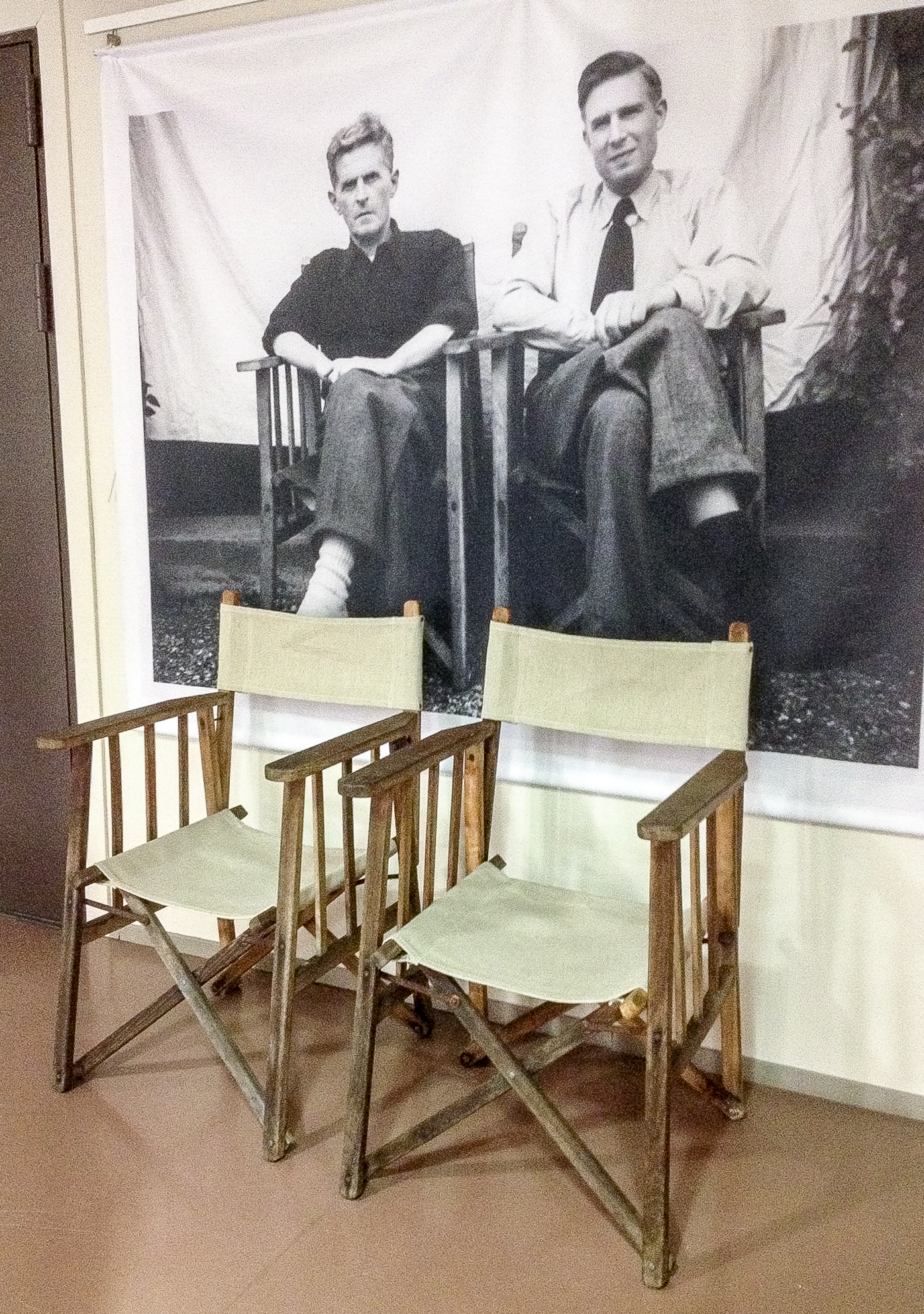
W. S. Farren, later director of the Royal Aircraft Establishment, Farnborough, and David Pinsent, aboard their plane in 1918
As part of an exchange program between both cities real and fictive stories are interwoven to revive the famous philosopher and his fellow. From July 25 to August 8 2016 Verena Henetmayr, Thomas Philipp and Andre Zogholy from qujOchÖ will visit Birmingham to intervene at various places that are connected to the life of Wittgenstein and Pinsent. You have the opportunity to experience the meaning of dictation of „Notes on Logic“ at 32 Paradise Street. You will find a strange animalic reincarnation of Wittgenstein and Pinsent at 44 Lordswood Road. You can figure out why Wittgenstein was annoyed by Richard Strauss’s Salome at the Town Hall. You will have the chance to enter the chapel of the lonely hearts at 59 Selly Wick Road and cry about the loss of David Hume Pinsent. And you can send your messages from the intermedia state to 105 Harborne Road, the last domicile of David.

Lordswood Road 44, residence of the family Pinsent until 1913
Besides a presentation at Digbeth First Friday the artists will talk about GOODBYE WITTGENSTEIN on July 28 at 6:30 pm at BOM. They will give a sneak preview on the interventions there and reflect on the life of Wittgenstein and Pinsent in Birmingham and Linz. The public talk is followed by an informal networking on the cultural connex of Birmingham and Linz with Darryl Georgiou, Clayton Shaw (Sampad) and BOM Fellows.

Extract from “Notes on Logic”, written on a typewriter Adler No. 7 from 1911. We will use this typewriter in one of the interventions in 32 Paradise Street. It’s a kind of re-enactement on the dictation of “Notes on Logic”. We will ask passers-by if they want to sit down at an old desk there. Then we will dictate “Notes on Logic” to them. In German of course (like Wittgenstein did in Oct 1913). They should type whatever they hear on the Adler No. 7, no matter if they understand and speak German or not. This intervention is called “The Meaning of Dictation”.
There will be another public talk on August 4 at 7:00 pm. qujOchÖ will talk about their work at the interfaces of art, politics, society, technology and science. They will show what it feels like to enter a wellness area with the famous French philospher Michel Foucault, how to burn 9,6 million pounds on a Brazilian beach and why almost no one in Austria knows anything about „Sound of Music“. Moreover they will serve super sweet Austrian Kaiserschmarrn & Zwetschkenknödel to the audience.
Supported by Austrian Cultural Forum London, Austrian Federal Chancellery – Arts and Culture, State of Upper Austria and City of Linz.

Volume 5 / Number 1 (Jun 2016),
eds. Anne-Marie Søndergaard Christensen, Martin Gustafsson, Yrsa Neuman
http://www.nordicwittgensteinreview.com/issue/view/NWR%205%20%28No%201%29%202016
INVITED PAPER
Thinking about Animals: James, Wittgenstein, Hearne
Russell B. Goodman 9-29
ARTICLES
Wittgenstein and Family Concepts
Odai Al Zoubi 31-54
Cora Diamond and the Moral Imagination
Christopher Cordner, Andrew Gleeson 55-77
Wittgenstein on Perspicuous Presentations and Grammatical Self-Knowledge
Christian Georg Martin 79-105
On a Philosophical Motivation for Mutilating Truth Tables
Marcos Silva 107-128
BOOK REVIEWS
Review of Inside Ethics: On the Demands of Moral Thought by Alice Crary
Stina Bäckström 129-136
Review of Representation and Reality in Wittgenstein’s Tractatus by J.C. Zalabardo
Silver Bronzo 137-142
Review of Formen des Klärens by Christian Erbacher
Tea Jankovic 143-147
NWR is on Facebook. https://www.facebook.com/NordicWittgensteinReview/
Nordic Wittgenstein Review publishes original contributions on all aspects of Wittgenstein’s thought and work – exegetical studies as well as papers drawing on Wittgensteinian themes and ideas in discussions of contemporary philosophical problems.
The journal is interdisciplinary in character, and publishes contributions in the subject areas of philosophy and other human and social studies including philology, linguistics, cognitive science, and others. Each issue includes an invited paper, an interview, a peer-reviewed articles section, a section in which seminal works are re-published or where previously unpublished archive materials are presented, as well as a book review section.
The journal is published by the Nordic Wittgenstein Society (NWS).
Wittgenstein Source continues to publish new editions other than the Wittgenstein Archives’ own Bergen Nachlass Edition. Recent editions included:
Wittgenstein Source is now delighted to announce the publication of Martin Pilch’s “Prototractatus Tools” (PTT).
PTT gives access to prepared new transcriptions of Wittgenstein Nachlass item Ms-104, the so-called “Prototractatus”.
The editor, Martin Pilch prepared these highly sophisticated transcriptions with the aim of providing the best possible textual basis for facilitating the reconstruction of the composition process of the Tractatus text. PTT utilizes a multiplicity of representation formats and colour schemes in order to make various aspects of the Tractatus text genesis visible. An extension of the site is planned, and transcriptions of the Tractatus typescript Ts-202 are already in preparation.
Check PTT out on Wittgenstein Source!
von Wright exhibition at the Helsinki National Library.
http://www.helsinki.fi/wwa/von_Wright_exhibition.pdf
Video (external link)
The Philosophy Department at the University of Hertfordshire is delighted to invite you to the annual Francis Bacon lecture delivered this year by Professor Raimond Gaita on Thursday 19 May at 19:00. Professor Gaita will speak on ‘The Fragility of the Idea of a Common Humanity’. See below for further details, and to register your attendance to the lecture.
Please also note that the lecture will be preceded by a philosophy workshop on some themes in Professor Gaita’s work, in his presence. If you would like to attend the workshop, kindly send a separate email to Daniele Moyal-Sharrock: d.moyal-sharrock@herts.ac.uk.
We are delighted to invite you to the Francis Bacon annual lecture 2016 which is part of the philosophy public lecture series
The Fragility of the Idea of a Common Humanity
with guest speaker eminent philosopher Professor Raimond Gaita
Thursday 19 May, 18:30 – 20:00
N001, de Havilland Campus
This lecture is free of charge and open to all.
Pre-registration is required.
Book online or contact the Events Team by email events@herts.ac.uk or call 01707 284121
Speaker’s Abstract:
Ethically-inflected ways of speaking of humanity – as when we speak of seeing or failing to see the full humanity of others, of dehumanisation and of the common humanity of all the peoples of the earth – often go together with talk of universal human rights and sometimes with talk of the Dignity of persons or humanity. This is apparent in some of the preambles to important instruments of international law. Many philosophers believe that the concept of human rights contributes to the acknowledgement, by all peoples of the earth, of a common humanity. Some philosophers believe that the idea of the Dignity of persons (some speak of the ‘inalienable dignity’ of persons to which an unconditional respect is owed) rationally underpins the concept of universal human rights. In this lecture I shall argue that when our ways of speaking of human rights and the Dignity of persons cease to be ethically-inflected ways of speaking of humanity, they lose contact with the only vocabulary in which their importance can be made manifest.
About the speaker:
Over the past thirty years Raimond Gaita has developed an original, powerful and sometimes controversial conception of the nature of morality and ethical thought. He has made an outstanding contribution to contemporary analytic moral philosophy, not least for his distinctive vision of the nature of moral philosophy as an academic discipline.
Professor Gaita believes that it is generally a good thing for philosophers to address an educated and hard-thinking lay audience as well as their colleagues and thus he has contributed extensively to public discussion about reconciliation, collective responsibility, the role of moral considerations in politics, the Holocaust, genocide, crimes against humanity, education.
The University is proud to host the Francis Bacon lecture series alongside the Royal Institute of Philosophy.
These free public lectures aim to spotlight the valuable contribution and impact that philosophy makes to society. More information about the Francis Bacon Lecture series
Further information:
Light refreshments will be served from 18:30, lecture starts at 19:00
Confirmation of your booking and a parking permit will be sent electronically shortly before the event
University of Hertfordshire, College Lane, Hatfield, Hertfordshire AL10 9AB
[insert page=’39th-international-wittgenstein-symposium-2016′ display=’content’]