the Wörterbuch für Volksschulen
Désirée Weber
In the spring of 1923, Leopoldine Eichberger was practicing her orthography and grammar lessons under the watchful eye and strict guidance of Ludwig Wittgenstein, elementary school teacher. She was one of many elementary school pupils that Wittgenstein taught between 1920 and 1926, in the small villages of lower Austria. During that particular school year, he led his class in a project to make their own dictionaries: they collected words they were having trouble with, they hand-dyed the stiff paper used for the covers, and they bound everything together with red ribbon.
This period of Wittgenstein’s life usually gets passed over as a curiosity or a surprising point of trivia. However, his training and occupation during these six years – not to mention the remaining artifacts of his efforts – shed new light on and heighten the significance of the prevalent teaching and learning references woven into his later philosophy. Instead of a break from his prior philosophical interests and method, Wittgenstein’s years as a teacher reveal his continued interest in the philosophy of language and its practical, everyday manifestations.
In 1926, as a culmination of the dictionary project he had his students complete, Wittgenstein published the Wörterbuch für Volksschulen [Dictionary for Elementary Schools]. Known as the second of only two works published in Wittgenstein’s lifetime, it is the most important touchstone that links these two periods of his life and work.
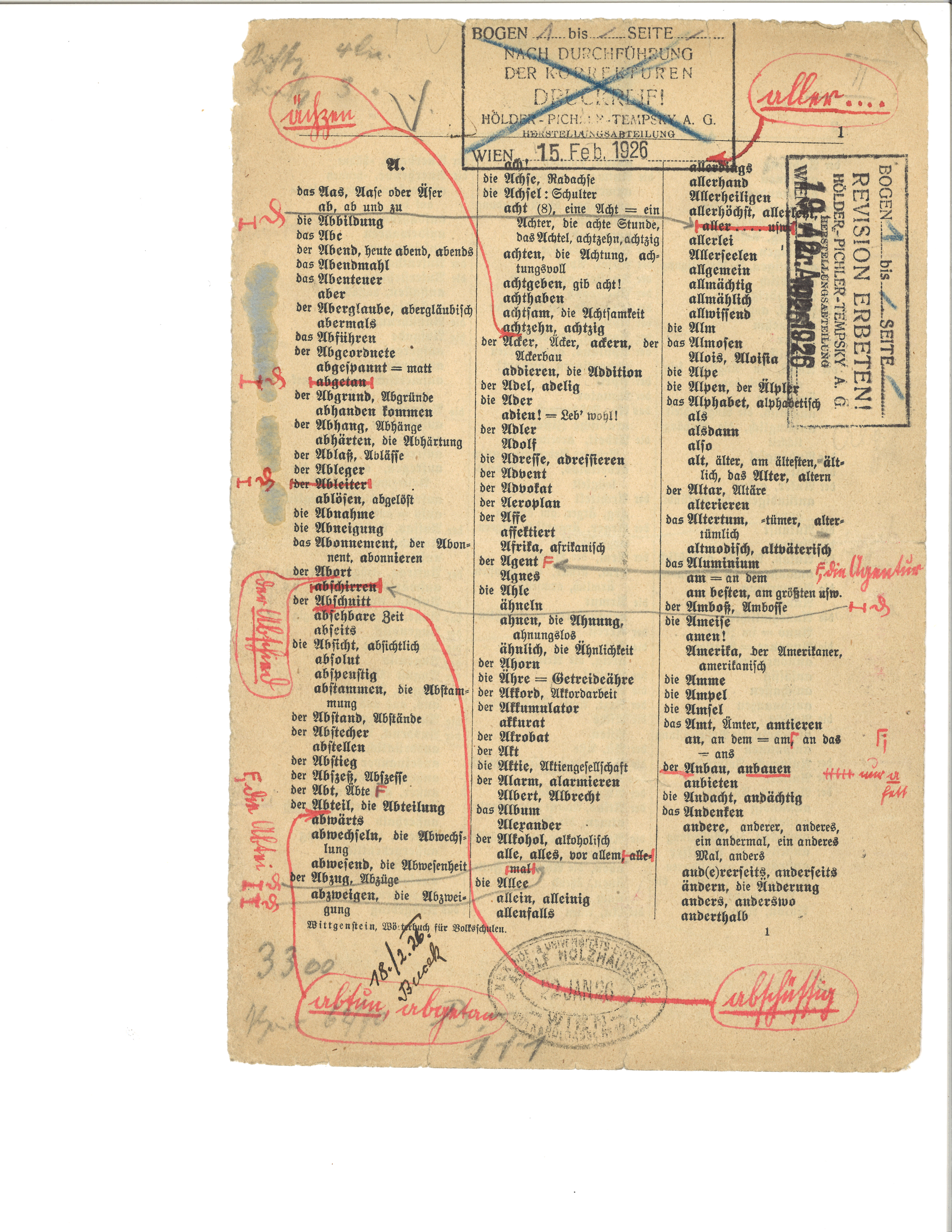
Published versions of the dictionary do exist but are rare but, so to understand Wittgenstein’s method at the time of its composition and its relation to his later philosophical work, more research on its provenance was warranted. Luckily, a few artifacts, manuscripts, and correspondences related to the Dictionary have survived. Besides the so-called preface to the Dictionary, a set of publisher’s proof pages with copious marginalia is the most promising prospect for insight into the process by which the Dictionary took shape. It was this document, held in a private collection, which I tracked down and have since examined.
This set of proof pages is composed of 10 sheets interlaid booklet-style, with the word entries arranged in three columns. The editorial marks that fill the margins are rendered in 3 different colors and at times overlap one another. The first page of each section bears the stamp of Adolf Holzhausen, head editor of the Dictionary’s publisher (Hölder-Pichler-Tempsky), and a well-known Viennese patron of academic research.
Although there is some question whether or which of the marks are in Wittgenstein’s own hand, the contents of the dictionary and the corrections yield a fascinating view of the words that Wittgenstein deemed central to the forms of life and language-games in which his students were immersed. Many entries such as Alm (mountain pasture) and Senner (alpine shepherd) relate directly to the geography, and locale in which Wittgenstein taught. Other common categories of words have to do with religion (Apostel, Philister) or may have formed the basis of Wittgenstein’s other lessons for the school children, including about Arabic numerals (arabische Ziffern) and rules (Regel).
Noteworthy is also Wittgenstein’s inclusion of words and descriptions that refer to the children’s dialect or colloquial usage. Some word entries make note of “Mundart” or how a particular word would be used in the specific region of Austria in which he taught. The care with which he selected and constructed this dictionary is evident, and is also in line with what is known of his punctilious approach to his philosophical endeavors before and after his career as a teacher.
The Dictionary is thus a link from Wittgenstein’s years as an elementary school teacher to works such as the Brown Book and the Philosophical Investigations. The connection goes beyond the frequent references to teaching that can be found in these later works: the influence of his previous career is also palpable in his focus on the processes by which someone – usually a child – learns a word or language-game anew. In this process, the ‘agreements in judgment’ necessary for meaningful language use are continuously renegotiated. Questions about the basis on which to ground language (if that is possible at all), in turn, get to the heart of Wittgenstein’s method and insights in the years after his return to Cambridge in 1929.

Désirée Weber received her PhD from Northwestern University, completed under the supervision of James Farr and John G. Gunnell, in 2016. She is currently an Assistant Professor of Political Theory at the College of Wooster in Ohio.