Author: BWS Vice-President (page 20 of 24)

Wittgenstein and the Social Sciences

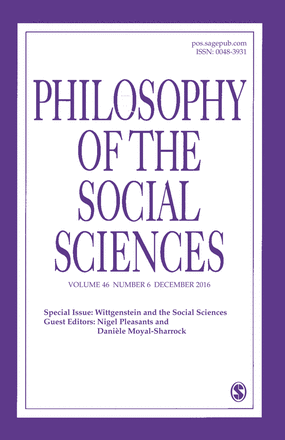
The BWS is pleased to report that the special issue of Philosophy of the Social Sciences with papers from the 2015 BWS conference has been published.

Wittgenstein and the Social Sciences

Special Issue of Philosophy of the Social Sciences December 2016 46 (6)

Guest editors: Nigel Pleasants and Daniéle Moyal-Sharrock

Table of Contents

John R. Searle: Insight and Error in Wittgenstein

John Dupré: Social Science: City Center or Leafy Suburb

Sabina Lovibond: Wittgenstein, Tolstoy, and the “Apocalyptic View”

John G. Gunnell: Social Inquiry and the Pursuit of Reality: Cora Diamond and the Problem of Criticizing from “Outside”

Albert Ogien: Obligation and Impersonality: Wittgenstein and the Nature of the Social


http://pos.sagepub.com/content/current

NB: Access to the special edition requires a fee or institutional login.

CFP:40TH INTERNATIONAL WITTGENSTEIN SYMPOSIUM 20

CALL FOR PAPERS

40th INTERNATIONAL WITTGENSTEIN SYMPOSIUM 2017

Kirchberg am Wechsel, 6 – 12 of August 2017
THE PHILOSOPHY OF PERCEPTION AND OBSERVATION
Scientific Organizers:
Christoph Limbeck-Lilienau (Vienna)
Friedrich Stadler (Vienna)

Sections:
1. Wittgenstein
2. Perception and Intentionality
3. Perception and Concepts
4. The Epistemology of Perception
5. Theories of Perception in the Cognitive Sciences
6. Theories and Scientific Observation

Workshop (organizers: Johannes Brandl und Guillaume Fréchette): “Franz Brentano and the Myth of the Given” (on the occasion of the Brentano Centennial), participants: Johannes Brandl, Guillaume Fréchette, Uriah Kriegel, Olivier Massin, Michelle Montague, Marcello Oreste Fiocco

The list of invited speakers includes:

Johannes Brandl, Salzburg
William Brewer, London
Tyler Burge, Los Angeles
Ophélia Deroy, London
Marcello Oreste Fiocco, Salzburg
Guillaume Fréchette, Salzburg
Nivedita Gangopadhyay, Bergen
Christopher Gauker, Salzburg
Kathrin Glüer, Stockholm
Pierre Jacob, Paris
Mark Eli Kalderon, London
Uriah Kriegel, Paris
Michael G. F. Martin, London
Julian Kiverstein, Amsterdam
Olivier Massin, Geneva
Sofia Miguens, Porto
Michelle Montague, Austin
Erik Myin, Antwerp
Bence Nanay, Antwerp
Matthew Nudds, Coventry
Jesse Prinz, New York
Athanassios Raftopoulos, Nikosia
Johannes Roessler, Coventry
Susanna Schellenberg, New Jersey
Hans Sluga, Berkeley
Paul Snowdon, London
David Stern, Iowa
Charles Travis, London
Michael Tye, Austin
Frédérique de Vignemont, Paris

Deadline for submission of contributed papers (to section 1-6): 15th of April, 2017
(Instructions for authors:
http://www.alws.at/index.php/symposium/view/call_for_papers/)

Antecedent to the symposium:

9th LUDWIG WITTGENSTEIN SUMMER SCHOOL 2017 (David Stern, Hans Sluga)

2–5 of August 2017 in Kirchberg am Wechsel, Austria

Topic:
Meaning, Mind, and Action: Wittgenstein’s Lectures, Cambridge, 1930-33

With: David Stern (Iowa) and Hans Sluga (Berkeley)
Scientific Organization and Direction: Volker A. Munz (Klagenfurt)

(For applications see:
http://alws.at/de/index.php/summerschool/)

For further information:
http://www.alws.at/

.

Call for Papers: Wittgenstein’s Notebooks 1914-1916

Call for Papers
The colloquium ‘Wittgenstein’s Notebooks 1914-1916’ will take place at the Université du Québec à Montréal and Université du Québec à Trois-Rivières (Montréal and Trois-Rivières, Canada), on May 4-6, 2017.

The aim of the colloquium is to encourage a more systematic study of Wittgenstein’s Notebooks 1914-1916, hoping to achieve a better understanding of his earliest philosophy, and to understand how they prefigure or differ from those expressed in the Tractatus. The hope then is to reach, on a broad range of topics, a better understanding of the Tractatus itself and the originality of the Notebooks.


Invited speakers:

Guido Bonino (Università degli Studi di Torino)
Pasquale Frascolla (Università degli Studi della Basilicata, Potenza)
Sébastien Gandon (Université Blaise-Pascal, Clermont-Ferrand)
Fraser MacBride (University of Manchester)
Ray Monk (University of Southampton)
Kevin Mulligan (Université de Genève)
Ian Proops (University of Texas at Austin)
Janyne Sattler (Universidade Federal de Santa Maria)
Genia Schönbaumsfeld (University of Southampton)
Peter Sullivan (University of Stirling)
Peter Simons (Trinity College, Dublin)
José Zalabardo (University College, London)
Limited funding is available for up to two PhD students or young scholars, who have obtained their diploma within the past 5 years.
Proposals should not be more than 1000 words in length, written in English or French, and should be sent to one of the organizers, below, by February 1, 2017.
Proposals will be anonymously refereed and notice of acceptance will be sent by the second week of March.

Organizers:

Mathieu Marion (UQAM)
marion.mathieu@uqam.ca
&
Jimmy Plourde (UQTR)
jimmy.plourde@uqtr.ca

The colloquium is organized with the support of the British Wittgenstein Society

Book Reviews

We have some great books available for review at the moment. Make sure you have a look at our books section in the main menu
https://project1-nsylgljk0z.live-website.com/resources/book-reviews-requests#available

Dale Jacquette (1953-2016)

The BWS was deeply sorry to learn that Dale Jacquette has passed away. Dale was a superb individual, a passionate philosopher and an eminent Wittgensteinian. His love of philosophy and art was deep and infectious. He gave the Fourth BWS Biannual Lecture on ‘Wittgenstein’s Tractatus as Mystic Revelation’. Dale will be sorely missed, as a friend and philosopher. Our deepest condolences go to his beloved wife, Tina.
http://dailynous.com/2016/08/24/dale-jacquette-2016/

WHAT’S WRONG (AND WHAT’S RIGHT) WITH ORDINARY LANGUAGE PHILOSOPHY

Call for Abstracts

What’s Wrong (and What’s Right) with Ordinary Language Philosophy?

The 8th Nordic Wittgenstein Society Symposium
Åbo Akademi University (Turku, Finland) May 5-6, 2017
www.nordicwittgensteinsociety.org

The label “ordinary language philosophy” (OLP) was probably coined by its detractors. Common objections against OLP are that philosophers engaging in it gratuitously limit their attention to the most common ways of using words, that they give current or non-specialized usage normative ascendancy over more sophisticated uses, and that they neglect the need for empirical investigation in settling issues of usage.
In defence of OLP it has been suggested that much of the criticisms are due to misunderstandings of methodologies such as those adopted by Wittgenstein, Austin, and others. The ordinary language philosophers are the ones who intend to approach language without preconceptions, by attending to the way words actually occur in interaction – not so much the language of everyday as the everyday of language. Nor are ordinary language philosophers out to chart maps of current or correct usage: their aim is rather to dissolve worries that arise out of misconstruals of our own ways of speaking. They are not in the business of new discoveries but rather of reminding ourselves of how we speak.
The aim of this closing conference of our research project “The Philosophical Import of Ordinary Language Philosophy: Austin, Ryle, Wittgenstein, and their contemporary significance” (2013-17) is to explore the aspirations and procedures of ordinary language philosophy. Are they unified or diverse? Are they intelligible? Are they defensible? How do philosophical outlooks that have an apparent affinity with ordinary language philosophy, such as experimental philosophy or various contemporary forms of contextualism, relate to OLP?


We invite submissions from those wishing to present a paper on a topic related to the conference theme. Speakers will be given 20 minutes for presentation and 15 minutes for discussion.
Please send an abstract of up to 500 words to kim.berts@abo.fi by February 1, 2017. Applicants will be notified of the selection result by March 1, 2017.
Organizers
The conference is organized by the Nordic Wittgenstein Society and the research project “The Philosophical Import of Ordinary Language Philosophy” [ http://www.abo.fi/fakultet/filosofiprojekt ], which is financed by the Academy of Finland and coordinated by Professor Martin Gustafsson, Åbo Akademi University. The organizers are doctoral candidate Kim-Erik Berts, Professor emeritus Lars Hertzberg, and Dr Yrsa Neuman.

In Search of Ludwig Wittgenstein’s Secluded Hut in Norway: A Short Travel Film

By Kirsten Dirksen, the short film takes through the beautiful countryside of Norway, in search of the hut where Ludwig Wittgenstein exiled himself from society from time to time, first starting in 1913. Dirksen gives this preface to the film:

Over 100 years ago, philosopher Ludwig Wittgenstein went to the fjords of Norway to escape the scholarly world of Cambridge. His former teacher Bertrand Russell wrote, “I said it would be lonely, and he said he prostituted his mind talking to intelligent people.”

Not content with simply moving to the isolation of rural Norway- at the end of the Sognefjord (the deepest and second longest fjord)- Wittgenstein built his hut across the lake and halfway up a mountain from the nearest town (Skjolden). Measuring just 7 by 8 meters, the small cabin dubbed “Little Austria” (his native country) became his home on and off throughout his life (his longest stay here was 13 months).

Wittgenstein was fleeing the distractions and interruptions of a more social lifestyle and hoping to confront only his own thoughts. “Whoever is unwilling to descend into himself,” he wrote, “because it is too painful, will of course remain superficial in his writing.’” He wrote some of his most important work here (a precursor to his “Tractatus Logico-Philosophicus” and some of his “Philosophical Investigations”).

Today all that remains of his hut are its stone foundation and a very faint hikers trail up the mountain, though some Norwegians are trying to change this. Artists Marianne Bredesen, Sebastian Makonnen Kjølaas and Siri Hjorth (in collaborations with the Wittgenstein Society in Skjolden and funded by Public Art Norway) threw an all-expenses-paid vacation to bring fellow Oslo residents to the ruin. Inspired by Wittgenstein’s argument that “philosophical problems arise when language goes on holiday”, they are calling their art holiday “Wittgenstein on Vacation”. For part one, they entertained their guests with a weekend of lectures, meals and a Wittgenstein interpretation at the site of his cabin. We captured some of the show on our own journey to this disappearing piece of history.

http://www.openculture.com/2016/04/in-search-of-ludwig-wittgensteins-secluded-hut-in-norway-a-short-travel-film.html

Philosophical Investigations as Performance Philosophy

Wittgenstein’s Slapstick
Beth Savickey

Abstract

In “Performance Philosophy — Staging a New Field,” Laura Cull approaches performance as a source of philosophical insight and philosophy as a species of performance (Cull 2014, 15). This calls for a radical transformation of philosophy and its practices. What form might this take? Wittgenstein’s later philosophy provides one example. The language games presented in the opening remarks of the Philosophical Investigations (PI, [1953] 2001) are meant to be played out. They involve improvisation based on general scenes, stock characters, and linguistic play. When enacted, they are slapstick. As such, they offer a method of philosophical investigation in which clarity and insight are inherent in the performance itself. Wittgenstein’s language games were directly influenced by the subversive practices of Austrian commedia dell’arte and slapstick (through the works of Johann Nestroy and Karl Kraus). By their very nature, they challenge the pretensions of philosophical explanation and theory. Unlike attempts to compare Wittgenstein’s philosophy to theatre, enacting language games is a form of philosophical performance. Andrew Lugg notes that recent attempts to compare Wittgenstein’s philosophy to theatre problematize the opening remarks of the Investigations. However, enacting language games as a form of philosophical performance makes what is hidden, in all of its simplicity and familiarity, obvious, striking, and engaging.

://www.performancephilosophy.org/journal/article/view/34

Logic and Love in Birmingham

Press Release by the GOODBYE WITTGENSTEIN Project

Whereof one cannot speak, thereof one must be silent.“ This is a popular quote by the Austrian-British philosopher Ludwig Wittgenstein, who was born in Vienna, Austria, in 1889 and died in Cambridge, England, in 1951. It was written down in „Tractatus logico-philosophicus“ which is recognized as a significant philosophical work of the twentieth century. The predecessor of the Tractatus, the booklet „Notes on Logic“, was mainly written in Birmingham in 1913.

Birmingham? Why Birmingham? Not only because Wittgenstein studied nearby at the University of Cambridge but also as his best friend at that time, David Hume Pinsent (1891 – 1918), lived here in Harborne. Three artists from the Austrian based art group qujOchÖ and four artists from Birmingham, Trevor Pitt, Pete Ashton, Emily Warner and Mike Johnston, take the romantic love affair between those two men as a starting point for a series of works in public space in Birmingham and Linz. The project itself is called GOODBYE WITTGENSTEIN.

W. S. Farren, later director of the Royal Aircraft Establishment, Farnborough, and David Pinsent, aboard their plane in 1918

W. S. Farren, later director of the Royal Aircraft Establishment, Farnborough, and David Pinsent, aboard their plane in 1918

As part of an exchange program between both cities real and fictive stories are interwoven to revive the famous philosopher and his fellow. From July 25 to August 8 2016 Verena Henetmayr, Thomas Philipp and Andre Zogholy from qujOchÖ will visit Birmingham to intervene at various places that are connected to the life of Wittgenstein and Pinsent. You have the opportunity to experience the meaning of dictation of „Notes on Logic“ at 32 Paradise Street. You will find a strange animalic reincarnation of Wittgenstein and Pinsent at 44 Lordswood Road. You can figure out why Wittgenstein was annoyed by Richard Strauss’s Salome at the Town Hall. You will have the chance to enter the chapel of the lonely hearts at 59 Selly Wick Road and cry about the loss of David Hume Pinsent. And you can send your messages from the intermedia state to 105 Harborne Road, the last domicile of David.

Lordswood Road 44, residence of the family Pinsent until 1913

Lordswood Road 44, residence of the family Pinsent until 1913

Besides a presentation at Digbeth First Friday the artists will talk about GOODBYE WITTGENSTEIN on July 28 at 6:30 pm at BOM. They will give a sneak preview on the interventions there and reflect on the life of Wittgenstein and Pinsent in Birmingham and Linz. The public talk is followed by an informal networking on the cultural connex of Birmingham and Linz with Darryl Georgiou, Clayton Shaw (Sampad) and BOM Fellows.

Extract from "Notes on Logic", written on a typewriter Adler No. 7 from 1911. We will use this typewriter in one of the interventions in 32 Paradise Street. It's a kind of re-enactement on the dictation of "Notes on Logic". We will ask passers-by if they want to sit down at an old desk there. Then we will dictate "Notes on Logic" to them. In German of course (like Wittgenstein did in Oct 1913). They should type whatever they hear on the Adler No. 7, no matter if they understand and speak German or not. This intervention is called "The Meaning of Dictation".

Extract from “Notes on Logic”, written on a typewriter Adler No. 7 from 1911. We will use this typewriter in one of the interventions in 32 Paradise Street. It’s a kind of re-enactement on the dictation of “Notes on Logic”. We will ask passers-by if they want to sit down at an old desk there. Then we will dictate “Notes on Logic” to them. In German of course (like Wittgenstein did in Oct 1913). They should type whatever they hear on the Adler No. 7, no matter if they understand and speak German or not. This intervention is called “The Meaning of Dictation”.

There will be another public talk on August 4 at 7:00 pm. qujOchÖ will talk about their work at the interfaces of art, politics, society, technology and science. They will show what it feels like to enter a wellness area with the famous French philospher Michel Foucault, how to burn 9,6 million pounds on a Brazilian beach and why almost no one in Austria knows anything about „Sound of Music“. Moreover they will serve super sweet Austrian Kaiserschmarrn & Zwetschkenknödel to the audience.

Supported by Austrian Cultural Forum London, Austrian Federal Chancellery – Arts and Culture, State of Upper Austria and City of Linz.